
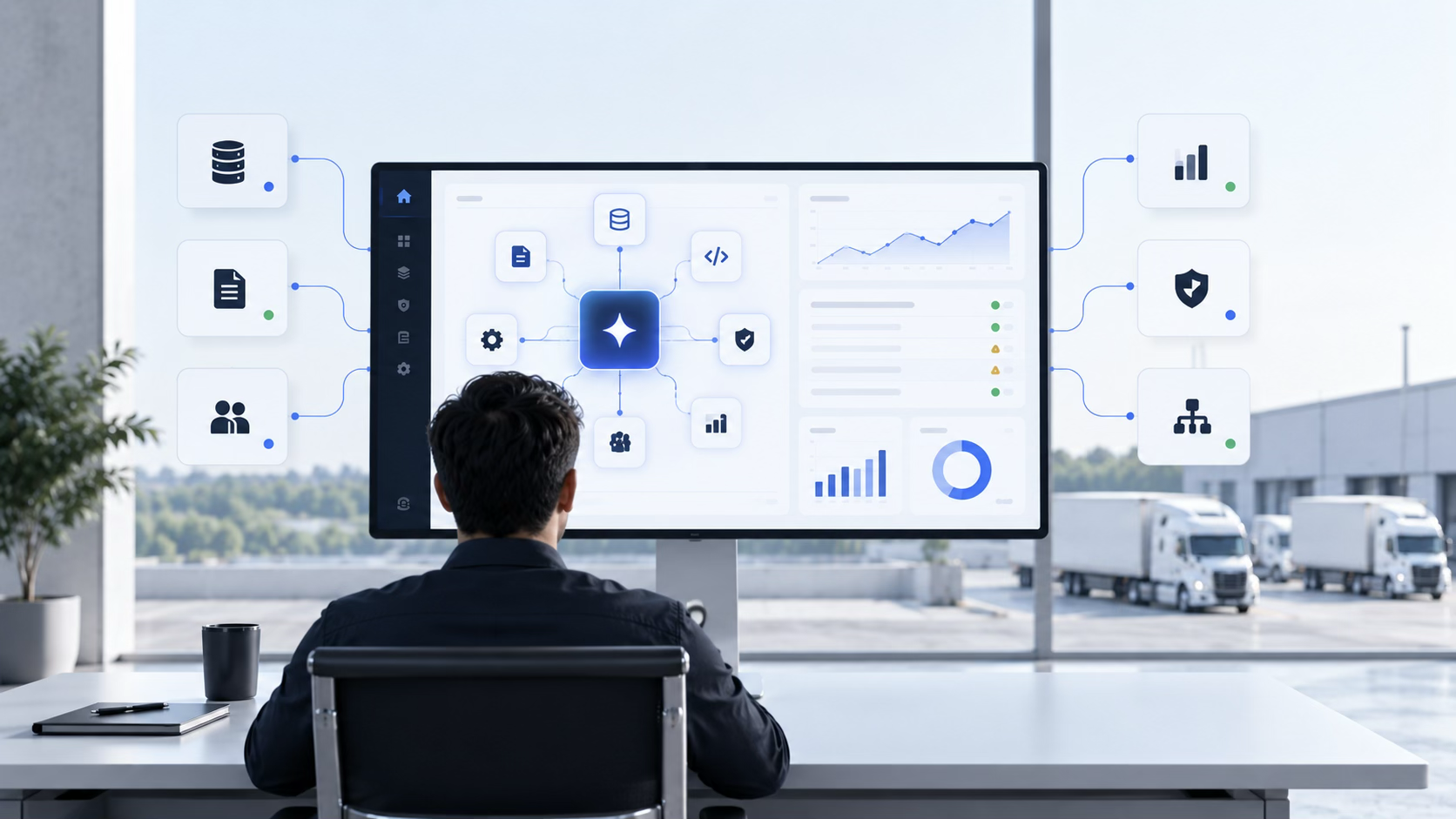
Enterprise AI is moving from isolated copilots toward networks of models, workflows, and AI agents that can take action across business systems. That creates a new management problem: how do organizations know what AI is running, who owns it, what data it can access, what approvals it needs, and whether it is performing safely?
An AI command center is an emerging answer. It is a centralized operating and governance layer for managing the enterprise’s AI assets across the AI lifecycle. Instead of leaving each team to build its own controls, a command center creates a common place for use case intake, registration, policy, approvals, observability, and performance review.
The exact architecture varies by organization. The concept is more important than any single product: AI needs a system of record and a management plane if it is going to scale responsibly.
What Is an AI Command Center?
An AI command center is a centralized system for governing and operating enterprise AI. It can track AI models, AI agents, agentic AI workflows, owners, data access, integrations, risk levels, deployment status, and business outcomes.
In practical terms, it gives business leaders, security teams, risk teams, and AI engineers a shared view of the organization’s AI stack.
A mature command center may include:
- Use case intake for proposed AI projects.
- An agent registry and model inventory.
- Assessment templates for risk, security, privacy, and business impact.
- Approval workflows tied to risk level and intended use.
- Identity and access controls through an identity provider.
- Integration inventory, including APIs and an MCP server where Model Context Protocol is used.
- Logging, lineage, evaluation, and observability.
- Controls for internal policies, external regulation, and operational performance.
This is different from a model development platform. A command center can sit above model training, inference, orchestration, data platforms, and business applications to provide a common governance layer.
Why Enterprises Need a Central AI Operating Layer
Shadow AI Is Hard to Govern
When employees or teams adopt AI tools independently, organizations can accumulate shadow AI: models, assistants, agents, prompts, and integrations that are not consistently inventoried or reviewed.
The problem is not experimentation itself. The problem is losing visibility into what exists, which systems it touches, what data it uses, and who is accountable for it.
An AI command center reduces that fragmentation by giving teams a standard path from idea to approved production use.
Agentic AI Raises the Stakes
Traditional generative AI often produces content for a person to review. Agentic AI can go further by selecting tools, retrieving data, calling services, and completing multi-step work.
That makes orchestration more important. Enterprises need to know which tools an agent can call, what credentials it uses, where approvals occur, and what happens when a workflow fails.
A command center provides a place to manage those dependencies instead of hiding them inside individual applications.
AI Governance Is Becoming Operational
Frameworks such as the NIST AI Risk Management Framework encourage organizations to manage AI risk across the design, development, deployment, and use of AI systems. NIST’s generative AI profile also emphasizes governance, tracking, documentation, and human review for generative AI contexts.
The EU AI Act adds legally binding requirements for certain uses and risk categories in the European Union. For example, Article 14 requires effective human oversight for high-risk AI systems. An AI command center does not automatically create compliance, but it can provide the inventory, approvals, records, and oversight workflows needed to operationalize governance requirements.
Core Components of an AI Command Center
1. AI Asset Inventory and Agent Registry
The foundation is a complete inventory of AI assets. That includes externally hosted models, internal AI models, applications, prompts, agent workflows, tools, datasets, and integrations.
An agent registry can record an agent’s owner, purpose, version, connected tools, risk classification, deployment environment, and approval status. This creates a searchable system of record for AI instead of relying on spreadsheets or tribal knowledge.
2. Use Case Intake and Assessment
A standardized use case intake process gives teams a consistent way to propose new AI work. Instead of asking only whether a model can perform a task, the intake should capture intended users, business process, data sensitivity, decision impact, and automation level.
Reusable assessment templates help legal, security, privacy, and risk teams evaluate projects without reinventing the review process every time.
3. Approval Workflows and Human Oversight
Not every AI use case requires the same review. A low-risk internal summarization tool may need fewer gates than an agent that can modify customer records or approve transactions.
Risk-based approval workflows let organizations match controls to consequence. Human oversight can be designed into the workflow so people approve, override, or review high-impact actions before execution.
This is especially important when AI moves from recommendation to action.
4. Identity, Networking, and Tool Access
An agent is only as governable as its access model. Enterprise teams should know which identity provider issues credentials, which networking services are reachable, and which data or APIs the agent can use.
Where organizations adopt Model Context Protocol, an MCP server may expose tools or data to agents. The command center should record those connections and apply the same principles used for other enterprise integrations: least privilege, environment separation, logging, and change control.
5. Observability, Lineage, and Performance
Observability should answer both technical and business questions. Did the agent complete the workflow? Which model and tools did it use? What data was retrieved? Where did it fail? Was a human override required?
Lineage provides traceability across versions, prompts, models, datasets, approvals, and outputs. That matters when teams need to investigate an incident, compare versions, or explain why a workflow behaved differently after a change.
The output should be more than logs. It should produce actionable insights that help operators improve reliability, cost, quality, and control.
How the AI Command Center Fits the AI Stack
An enterprise AI stack may include cloud infrastructure, data platforms, analytics services, model endpoints, vector databases, application frameworks, networking services, and business systems. Some organizations may use platforms such as Databricks for data and AI workloads, while others combine multiple vendors and internal services.
The command center is not necessarily where model training happens. It is the layer that connects governance and operations across the stack.
That distinction reduces operational friction. Engineers can continue using the tools best suited to development while the organization maintains a shared inventory, common controls, and standard reporting.
Standards, Policies, and Governance Frameworks
A good command center should be able to map internal controls to external frameworks without hard-coding the organization to a single standard.
The NIST AI RMF provides a voluntary framework for managing AI risk and is widely useful as a governance reference. The EU AI Act creates regulatory obligations that depend on the system and context. Internal policies may add requirements around privacy, cybersecurity, human review, procurement, data retention, or acceptable use.
Some organizations also evaluate emerging specifications and governance schemas, including concepts such as an AI UC-1 standard, to make use-case records and controls more portable. Whether or not a particular standard becomes dominant, the practical need is the same: a consistent way to describe what an AI system does, what it touches, and how it is governed.
A Practical Rollout Model
Enterprises do not need to build the entire AI command center at once.
Phase 1: Inventory
Start by identifying models, agents, vendors, owners, and production use cases. Find the highest-risk forms of shadow AI first.
Phase 2: Standardize Intake
Create a common use case intake form and lightweight assessment templates. Establish ownership and basic internal policies.
Phase 3: Add Risk-Based Approvals
Build approval workflows around data sensitivity, actionability, user impact, and regulatory exposure.
Phase 4: Connect Runtime Observability
Bring logs, agent actions, evaluation results, and incident data into the command center. Connect the records to the agent registry and model inventory.
Phase 5: Optimize the Portfolio
Use operational and business performance data to decide which AI projects to scale, revise, retire, or consolidate.
From Experiments to Managed AI Operations
The next stage of enterprise AI is not simply more models. It is more coordinated AI operating inside real business processes.
An AI command center gives organizations a way to move from disconnected experiments to a governed portfolio of AI agents, models, and workflows. By combining inventory, orchestration, approvals, observability, lineage, and human oversight, it helps leadership see what AI is doing and gives technical teams a consistent way to scale it.
For physical operations, the same principle shows up in a more domain-specific form. Hyperscale’s Terminal is designed as a command center for trucking operations: it connects existing systems, lets AI agents handle routine cross-system work, and keeps the human team in control of consequential decisions. The broader enterprise lesson is similar: AI scales best when action, context, and oversight live in the same operating model.
About Hyperscale Systems
Hyperscale Systems has pioneered a unified AI command center that transforms operational communications across physical industries. Founded by logistics technology veterans with deep expertise from leading companies like Samsara, Hyperscale integrates seamlessly with major TMS, FMS, and telematics providers to deliver contextual agentic workflows that eliminate operational bottlenecks while enhancing human capability.