
If you are evaluating an automated TMS, it is easy to assume the goal is simple: automate more of the work that happens inside your transportation management system. That can be valuable. Modern TMS automation can reduce repetitive clicks, standardize workflows, and help operations teams move freight with less manual effort.
But trucking work rarely stays inside one system.
A dispatcher may start with a load in the TMS, check a driver’s location in telematics, confirm hours in the ELD, review a maintenance issue elsewhere, call the driver, then return to the TMS to update the load. The technology may already exist. The problem is that a human is still moving the context from one system to the next.
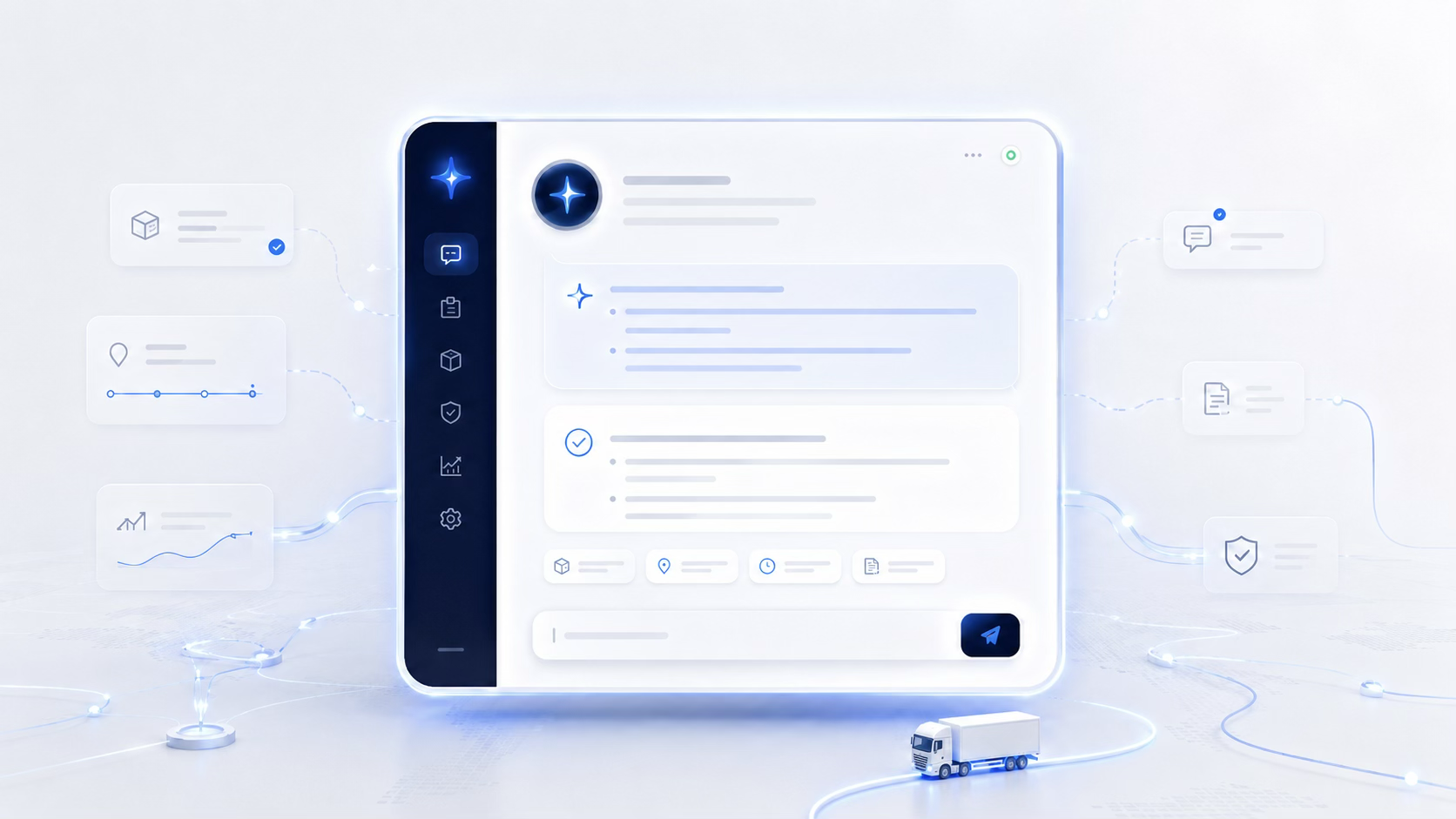
That is where an AI operations layer is different. Instead of replacing the TMS, it sits across the systems you already run and helps complete the cross-system legwork.
The distinction matters because an automated TMS and an AI operations layer solve different parts of the same operating problem.
What an Automated TMS Does Well
A TMS, or transportation management system, is usually the operational system of record for freight movement. It helps teams manage loads, customers, rates, carriers, planning, execution, and related transportation workflows.
Depending on the platform and configuration, an automated TMS may support processes such as:
- order management and order fulfillment
- carrier selection and procurement
- route planning and route optimization
- load planning and load optimization
- automated dispatch
- rate negotiation and rating workflows
- shipment status and on-time performance reporting
- invoicing and freight audit
- advanced analytics for transportation performance
For shippers, freight brokers, 3PLs, carriers, and other logistics providers, those capabilities can create meaningful cost savings because the team can process more work with fewer manual steps.
A TMS may also connect with adjacent enterprise systems. An ERP can pass customer, financial, or order data into the transportation workflow. A WMS, or warehouse management system, can coordinate shipping activity with warehousing and inventory management. These integrations matter in broader supply chain management because transportation is only one part of the flow from procurement through delivery.
An AI-powered TMS may go further by applying artificial intelligence or machine learning to planning, predictions, recommendations, and workflow automation. For example, it may help with route optimization, carrier selection, or exception detection using real-time data.
The key question is not whether the TMS can automate. It is where the automation boundary ends.
Where TMS Automation Reaches Its Boundary
The TMS is only one part of a trucking company’s operating environment.
Fleet management teams also rely on telematics, an ELD, maintenance software, email, phone systems, safety tools, customer portals, and sometimes a mobile app for drivers. Each system holds a different piece of the operating picture.
Consider a simple question: Can this driver make the next appointment on time?
The answer may require:
- the current load and stop sequence from the TMS
- current location from telematics
- remaining hours of service from the ELD
- equipment status from fleet management or maintenance software
- customer appointment requirements from a document, email, or portal
The TMS can be the right place to store and update the load record. But it may not be the place where every relevant signal originates.
This gap becomes more visible as fleets grow. Scalability is not just about processing more loads inside one application. It is about preventing the number of cross-system lookups, calls, and handoffs from growing at the same rate as the operation.
What an AI Operations Layer Changes
An AI operations layer works above the existing stack. It connects to the systems of record, gathers the context required for a task, and helps execute the routine steps across them.
At Hyperscale, that is the role of Vic. Instead of asking operators to replace the systems they already use, Vic is designed to work across TMS, telematics, maintenance, communications, and related tools. The human stays in control of consequential decisions while the AI handles the repetitive legwork.
That changes the unit of automation.
With traditional TMS automation, the unit is often a workflow inside the TMS: create an order, assign a carrier, plan a route, trigger an invoice.
With an AI operations layer, the unit can be the operational task itself: figure out what is happening, gather the right context, prepare the next action, and route the result to the person or system that needs it.
This is the shift from visibility to execution. A dashboard or alert can tell the team something happened. A cross-system agent can help do the next several steps.
Example: From Rate Confirmation to Delivery
The difference becomes clearer when you follow one load across the day.
1. Load Intake
A rate confirmation arrives by email. Instead of manually retyping the document, an AI agent can extract the shipment details, resolve customer information, validate required fields, check for a duplicate, and prepare the order for review before writing it into the TMS.
That supports the same outcome as TMS automation, but the workflow begins outside the TMS. Automated load entry is a good example of why the handoff between email, documents, and the system of record matters.
The same principle can apply to a full truckload, LTL, or less than truckload workflow, although the rules and data requirements may differ.
2. Planning and Assignment
The TMS can remain the core environment for load planning, route planning, carrier selection, and dispatch. If a fleet is using its own equipment, the next decision may require information outside the TMS: driver availability, equipment status, location, and hours of service.
An AI operations layer can pull those signals together so the dispatcher reviews the situation instead of manually assembling it.
3. In-Transit Execution
Once the truck is moving, real-time data becomes more important. Shipment status may depend on GPS, driver communication, HOS, appointment details, and exception conditions.
The goal is not to make autonomous decisions about everything. The goal is to reduce the routine coordination around those decisions: gather context, identify what needs attention, prepare an update, and escalate when judgment is required.
For compliance-sensitive data such as HOS, the underlying ELD remains the source of truth because electronic logging devices record and support hours-of-service data.
4. Customer and Back-Office Follow-Through
The final mile of the workflow may include updates to shippers, on-time delivery reporting, proof-of-delivery handling, invoicing, and freight audit. An automated TMS can streamline many of these processes internally. An AI operations layer becomes useful when the work spans communication channels, documents, portals, and multiple systems.
That cross-system model is why fleet management systems integration is an operations issue, not just an IT project.
Automated TMS vs. AI Operations Layer
Automated TMS
- Primary role: Automates transportation workflows inside the TMS
- System of record: Often yes
- Best at: Planning, execution, rating, order and freight workflows
- Data scope: Primarily TMS plus configured integrations
- Human role: Configure and manage automated workflows
- Replacement required: May require adopting or changing a TMS
AI Operations Layer
- Primary role: Coordinates tasks across the existing tech stack
- System of record: No; works with existing systems of record
- Best at: Cross-system lookup, data entry, communication, validation, and task execution
- Data scope: TMS plus telematics, ELD, maintenance, email, voice, portals, and other connected tools
- Human role: Review, approve, handle exceptions, and apply judgment
- Replacement required: Designed to sit on top of existing systems
The two approaches are not mutually exclusive. In many operations, the strongest architecture is an automated TMS plus an intelligence layer that handles the work between systems.
Which Approach Makes Sense for Your Operation?
Start with the bottleneck you are trying to remove.
If your biggest problem is inefficient routing, load optimization, order management, billing, carrier procurement, or other workflows that mainly live inside the transportation management system, improving the TMS may be the right first move.
If the bigger problem is that dispatchers and operations teams constantly switch between the TMS, telematics, ELD, maintenance tools, email, and phone calls to finish one task, another TMS feature may not solve the underlying issue.
That is the case for an AI operations layer.
It can also complement specialized TMS capabilities such as advanced analytics, demand planning, or rate negotiation without trying to recreate them. The point is not to make one platform own everything. The point is to let each system do what it does best while reducing the human work required to connect them.
The Better Question Is Where Work Happens
The automated TMS is an important part of modern transportation operations, but it is still one system in a larger stack.
As trucking companies add automation, the useful question is no longer, “How much can our TMS automate?” It is, “How much of the full operational task can happen without a person hunting through five systems?”
Hyperscale is built around that second question. Vic connects the systems carriers already run, handles repetitive cross-system work, and brings people back in for the decisions and exceptions that need experience.
If your team is evaluating an automated TMS, look beyond the feature checklist. Map the actual work from request to completion. The gaps between systems are often where the next layer of automation matters most.
FAQs
Q: What is an automated TMS?
An automated TMS is a transportation management system that automates repeatable workflows such as order management, route and load planning, carrier selection, dispatch, invoicing, and freight audit.
Q: Does an AI operations layer replace the TMS?
No. An AI operations layer works across the systems a carrier already uses. The TMS can remain the system of record while the AI layer gathers context and helps execute work across connected tools.
Q: When should a carrier consider an AI operations layer?
It is especially useful when the bottleneck is cross-system work: dispatchers switching among the TMS, telematics, ELD, maintenance tools, email, portals, and communications to complete one task.
Q: Can an automated TMS and an AI operations layer work together?
Yes. The TMS can manage core transportation records and workflows while the AI operations layer coordinates the repetitive work that happens between systems, with people handling decisions and exceptions.
About Hyperscale Systems
Hyperscale Systems has pioneered a unified AI command center that transforms operational communications across physical industries. Founded by logistics technology veterans with deep expertise from leading companies like Samsara, Hyperscale integrates seamlessly with major TMS, FMS, and telematics providers to deliver contextual agentic workflows that eliminate operational bottlenecks while enhancing human capability.