
Most logistics teams have already seen the limits of chatbots.
They can answer customer service FAQs, point someone to a knowledge base, or route a basic customer support question. That can help. But it does not solve the bigger issue inside fleet operations: dispatchers and driver managers still spend the day moving work across the TMS, telematics, email, phone systems, safety tools, maintenance platforms, and CRM records.
That is why the difference between AI agents versus chatbots matters. A chatbot responds to a prompt. An AI agent can understand the goal, check systems, follow guardrails, and move a task forward.
The Core Difference Between Chatbots And AI Agents
Chatbots are built around conversation. AI agents are built around workflow.
Traditional chatbots, especially rule-based chatbots, usually follow scripted paths. They detect customer intent, match it to a known answer, and respond. If the question fits the script, the interaction works. If it requires live data, judgment, or multiple steps, the chatbot usually hits a wall.
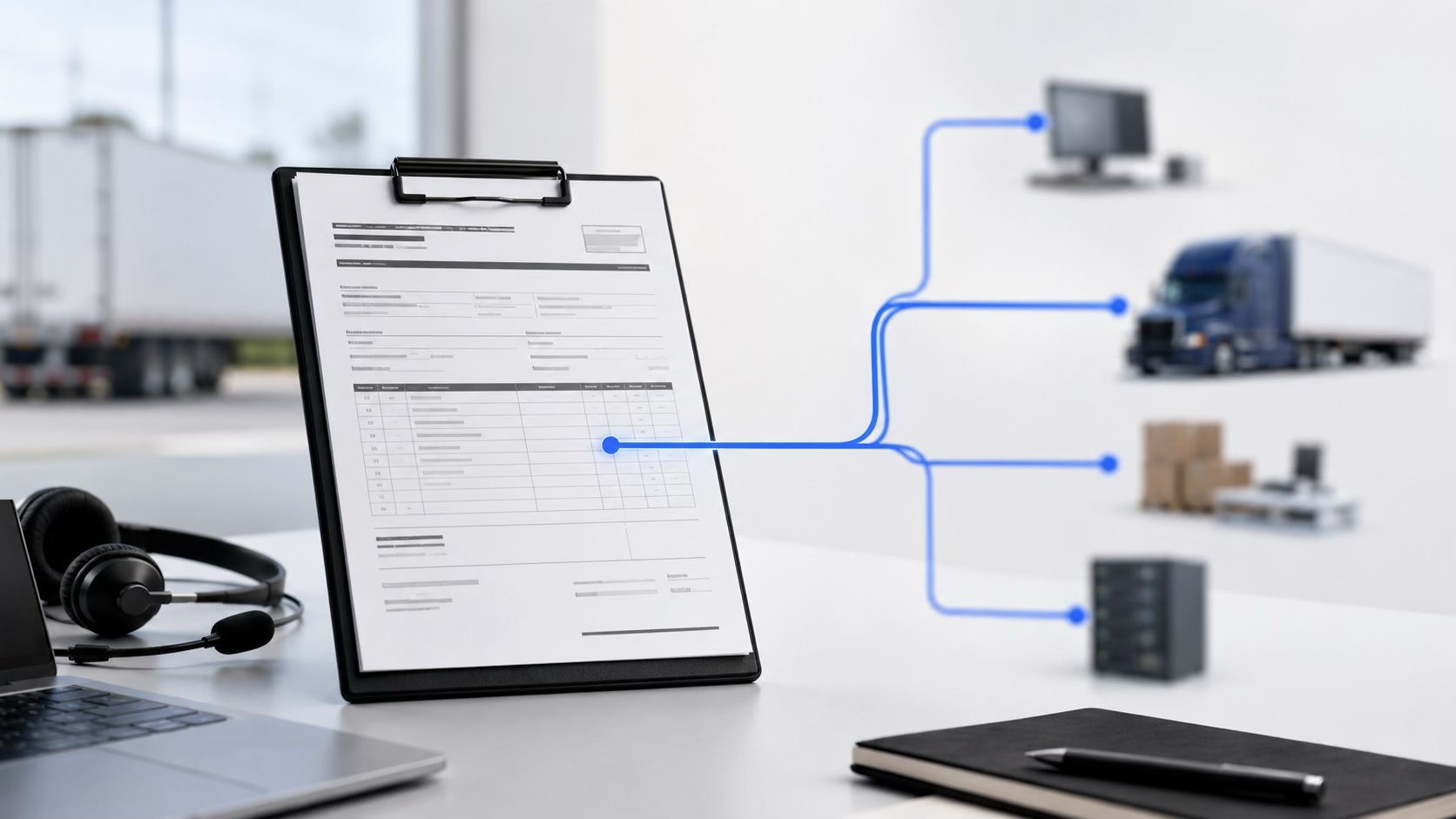
AI agents work differently. They use large language models, or LLMs, to interpret natural language, understand context, and decide which tools or systems to use. In logistics, an AI assistant might read a rate confirmation, extract load details, check the TMS, validate required fields, look up a driver’s available hours, and prepare the order for review.
The agent is not simply chatting. It is helping complete the work.
Why Basic Chatbots Fall Short In Logistics
Logistics work rarely lives in one system. A dispatcher may need McLeod for loads, Samsara or Motive for telematics and ELD data, Fleetio for maintenance, email for rate confirmations, a phone system for driver communication, and Salesforce or another CRM for customer notes.
Basic AI chatbots can be useful when the answer is static. They struggle when the answer depends on current load status, driver location, hours of service, equipment availability, or customer-specific instructions.
That creates three problems.
First, a chatbot depends heavily on a knowledge base. If the answer is written down, it can retrieve it. If the answer changes by the minute, it needs real integrations and orchestration.
Second, a chatbot often breaks when the work becomes multi-step. A driver asking, “Where should I fuel next?” may require current vehicle location, route, remaining hours, fuel policy, load appointment time, and company rules. That is not a one-answer FAQ. It is a set of multi-step tasks.
Third, many chatbots do not show their work. In trucking, teams need to know what the system checked, what data it used, and whether it is about to take an action. Operators need transparency, not a black-box answer.
What Makes An AI Agent Useful For Fleet Operations
Modern AI agents combine artificial intelligence, natural language processing, NLP, machine learning, and integrations into a system that can support real work. The underlying model may involve ChatGPT, Anthropic, deep learning, or another generative AI stack, but the model alone is not the product.
The value comes from connecting the AI to the workflow.
Context-Aware Reasoning
A context-aware agent understands the conversation as work unfolds. If a dispatcher asks about load 54210 and then asks, “How many hours does the driver have left?” the agent should know which driver to check.
That is the practical value of conversational AI in operations. The conversational interface should reduce steps, not force the team to repeat the same details over and over.
Live System Access
An AI agent needs access to the systems your team already uses. Without integrations, it can only summarize or guess. With integrations, it can query real systems, compare results, and prepare the next action.
MCP can help standardize how models connect to tools and data sources in some architectures, but the business value still comes from the workflow: the right systems, the right permissions, and the right approval path.
Multi-Step Workflow Execution
Agentic AI is strongest when a workflow has several steps. Order entry is a good example. It is not just reading a PDF. It can involve OCR extraction, customer matching, equipment type normalization, duplicate detection, field validation, and TMS submission preparation.
The agent gets the task most of the way done. The human reviews, corrects, and approves.
The same pattern applies to load notifications, wake-up calls, safety follow-ups, appointment scheduling, breakdown triage, and track-and-trace updates. These are multi-step workflows, not simple chat responses.
Guardrails And Human Oversight
Autonomous agents can be powerful, but trucking operations cannot treat every process like autopilot. Logistics teams need autonomous systems that are bounded by permissions, policies, and approvals.
Good guardrails define what the AI can answer, what it can draft, what it can recommend, and what it must escalate. That keeps intelligent automation useful without giving it too much control.
A Feedback Loop That Improves The Process
A strong feedback loop helps the system improve safely. When an operator corrects a field, rejects a recommendation, or changes a drafted message, that signal can reveal preferred formats, common exceptions, and workflow gaps.
The goal is not uncontrolled learning from every click. The goal is structured improvement that keeps people in control.
AI Agents Vs Chatbots: The Logistics Comparison
For logistics leaders, the real comparison is simple.
A chatbot answers a narrow question. An AI agent can investigate the question.
A chatbot pulls from a knowledge base. An AI agent can pull from live systems.
A chatbot follows a script. An AI agent can run multi-step workflows.
A chatbot is useful for basic customer support. An AI agent can support dispatch, driver communication, order entry, safety, customer updates, and back-office work.
A chatbot usually ends with an answer. An AI agent can end with a prepared action for review.
So the buyer question is not, “Can this tool chat?” It is, “Can this tool safely get operational work done across the systems we already use?”
Where AI Agents Fit In Logistics Teams
AI agents are most useful where the work is repetitive, data-heavy, and spread across systems.
In dispatch, an agent can look up driver, load, truck, and trailer information in one flow. In driver communication, it can answer routine questions, prepare instructions, or escalate exceptions. In order entry, it can extract fields from rate confirmations and prepare the TMS entry. In safety, it can support follow-ups, reminders, and check-ins after an event. In customer updates, it can prepare load notifications based on current status and ETA.
That matters for scalability. A team can only make so many calls, send so many emails, and check so many screens manually. Agents can handle routine volume while humans focus on the exceptions that require judgment.
How To Evaluate AI Agents For Logistics
When comparing AI agents, AI chatbots, and general-purpose tools, look for workflow depth.
Ask whether the platform can connect to your existing systems, complete multi-step tasks, show its work through logs or an audit trail, enforce guardrails, understand trucking-specific language, support both office users and drivers, and improve operations without forcing a TMS migration.
A generic AI assistant can be useful for writing and summarizing. A logistics AI agent needs to work inside the operation.
Why Hyperscale Is Built Around Agents, Not Chatbots
Hyperscale is built for trucking operations teams that already run on multiple systems. Vic, Hyperscale’s AI superagent, sits on top of existing tools and helps teams ask questions, run workflows, and complete repetitive work with human oversight.
It is not a TMS replacement. It is not a basic chatbot. It is an intelligence layer for fleet operations.
A dispatcher can bring work to Vic in plain language. Vic can look across connected systems, prepare the answer or action, and show what it checked. The operator reviews, approves, corrects, or escalates.
That is the practical difference between chatbots and AI agents in logistics. Chatbots talk about the work. AI agents help get the work done.
About Hyperscale Systems
Hyperscale Systems has pioneered a unified AI command center that transforms operational communications across physical industries. Founded by logistics technology veterans with deep expertise from leading companies like Samsara, Hyperscale integrates seamlessly with major TMS, FMS, and telematics providers to deliver contextual agentic workflows that eliminate operational bottlenecks while enhancing human capability.