
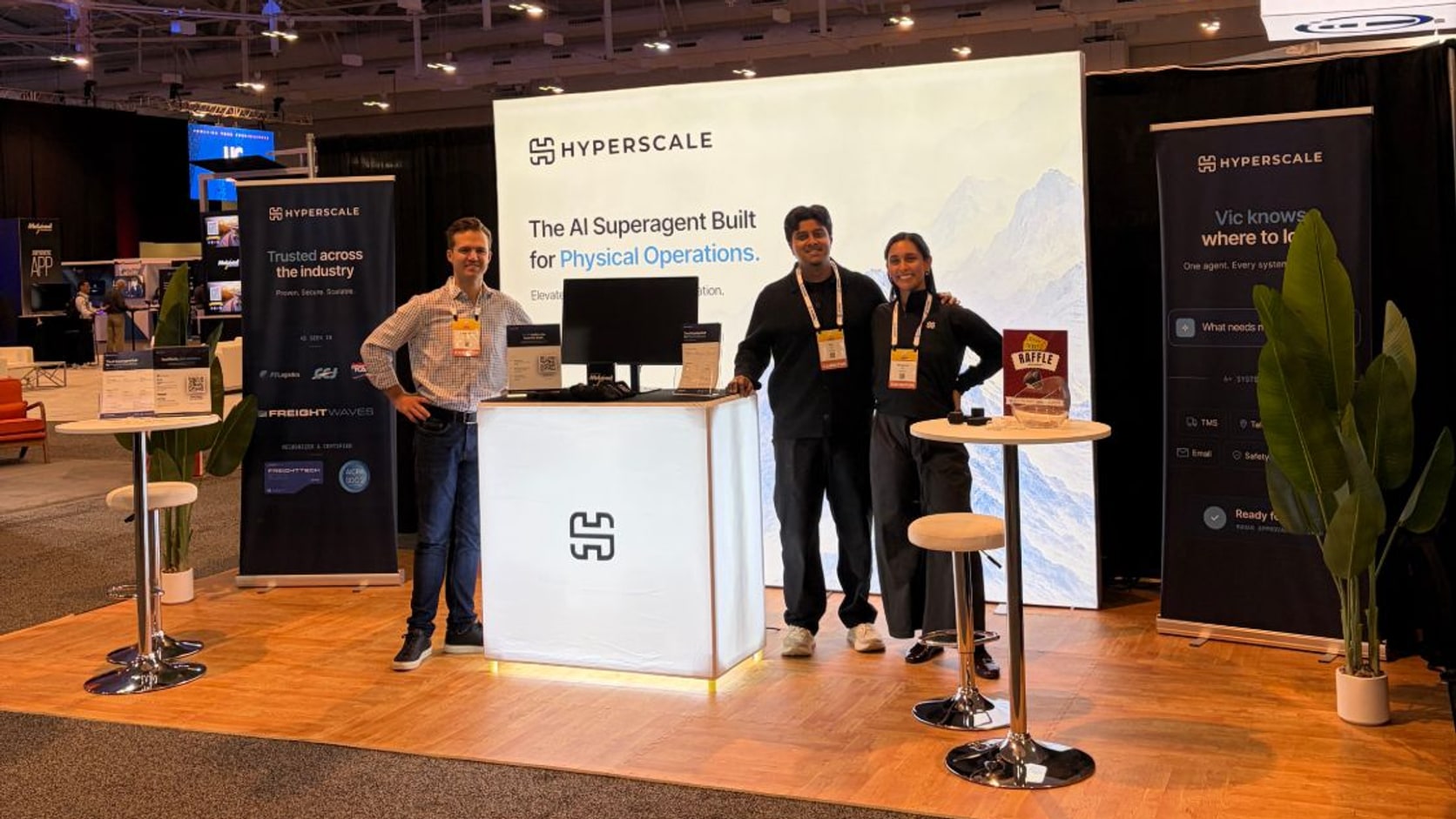
The most interesting thing we heard at McLeod User Conference 2026 was a question: “Can you show me how it works with our operation?”
We spent the week at Music City Center in Nashville, TN, talking with carriers, brokers, dispatch teams, IT leaders, and other vendors. People were still curious about AI. But curiosity alone was not enough. They wanted to see what happens when a driver calls after hours, a truck goes into the shop, a load status changes, or a customer asks for an update.
That shift matters. The McLeod Software User Conference brings together the people who run freight and the technology they use to run it. This year, the most useful conversations were about execution: which work can AI complete, which decisions stay with people, and how do you keep the whole process visible?
Here are five takeaways from our conversations at UC26 and what they mean for fleet operations.
1. Skepticism Has Turned Into Specific Questions
A year ago or so, many conversations about voice AI stopped at “We would never let a bot talk to our drivers.” At this year’s event, more operators were willing to test that assumption. They asked about call quality, escalation, access to load data, and what happens when the answer is not in the system.
That is a healthier discussion. A driver who calls at 2 a.m. about a pickup number needs an answer, not a technology pitch. If the question is routine and the information is available, AI should find it quickly. If the driver has a safety concern, an unclear repair status, or an exception that could affect a delivery, the system should get the right person involved with the context already gathered.
The same test applies to dispatch. A check call is only useful if the update reaches the load record and, when appropriate, the customer. Detention tracking is only useful if it captures the relevant timestamps and flags a claim before the window closes. Buyers were asking about those handoffs, not just whether an AI voice sounds natural.
2. Efficiency Is Back on the Buying Agenda
The freight market has been hard on operators. In our conversations, the mood was cautiously more constructive, but nobody sounded eager to add headcount for work a system could handle reliably.
That makes the investment question sharper. If volume rises, how does the team handle more loads, calls, appointments, and exceptions without increasing the manual work at the same pace? If volume stays uneven, where can the team recover time now?
Consider a fleet with a dispatcher fielding driver calls while checking an ELD, the TMS, a maintenance system, and a customer inbox. The expensive part is often the stitching. Each tool holds a piece of the answer, and a person has to collect the pieces, decide what changed, respond, and record it again.
AI earns its place when it removes that repeat work. Start with a measurable workflow: after-hours driver questions, proactive load updates, repair coordination, or billing follow-up. Track time to resolution, manual touches per load, and how often the work has to be corrected. A pilot should show improvement in the operation, not just an impressive demo.
3. The Near-Term Automation Opportunity Is in Operations
Autonomous trucks had a presence at UC26, and they remain an important long-term development. Yet in the fleet conversations we had, most near-term plans centered on the work around the truck: dispatch, planning, driver support, maintenance, and accounting.
That work is ready for a practical test today. A driver reports a breakdown. Someone needs to identify the truck and load, check the location and service history, alert maintenance, update dispatch, and decide what to tell the customer. The issue can touch four systems and several people before anyone can act.
An operational AI layer can gather the available context, open the right workflow, prepare messages, and route the exception to a human who has authority to decide. It should record what it did and where the information came from. The goal is less time spent reconstructing the situation and more time spent resolving it.
This is why the cab-versus-office debate misses some of the immediate value. For many fleets, the most useful automation this year begins with the phone call, inbox, load record, and maintenance ticket.
4. More AI Features Mean More Overlap to Manage
The UC26 expo floor reflected the breadth of the freight stack. McLeod Software listed planning vendor Optimal Dynamics, payments provider Relay Payments, and industry group TCA alongside TMS-connected, communications, and other technology companies. That range is useful for buyers, but it also raises a practical question: who owns the workflow when it crosses systems?
McLeod itself lists AI capabilities for LoadMaster and PowerBroker, including order entry, status updates, and planned voice use cases. Other vendors are adding AI to specific parts of the job, too. Those tools may work well within their lanes. A carrier still has to decide how a request moves from a driver conversation to the TMS, from the TMS to maintenance, and from an exception to a customer update.
For example, if a driver says a trailer is not ready, a voice tool may take the call, a telematics tool may show the location, and LoadMaster may hold the assignment. The buying question is whether the tools share enough context to resolve the issue, keep records current, and avoid making dispatchers reconcile three versions of the truth.
This is where integration quality beats a long feature list. Ask vendors to trace one real request across your systems, including the write-back, approval, and failure path. Then ask who supports the workflow if one of those systems changes.
5. “How Is Your AI Different?” Has a Better Answer Now
We heard this question repeatedly, and buyers should keep asking it. The strongest answer is a working demonstration of how the product handles your process.
For Hyperscale, that starts with Vic, our superagent for physical operations. Vic connects to the systems a carrier already uses and works across dispatch, driver communication, maintenance, safety, and back-office workflows. It comes with trucking-specific skills, but teams can shape those skills around their own rules and add new ones as the operation changes.
That combination matters. A ready-made check-call flow can help a team get started. But a real fleet may need different escalation rules for a late food shipment, a driver with a breakdown, and a customer who requires a call before any appointment change. The system needs to understand the context, use the right tools, follow permissions, and know when a person should approve the next action.
We do not think every workflow needs the same level of automation. Routine, reversible steps can move quickly. Consequential decisions should be staged for the person responsible. The standard is simple: can the system carry the work forward without making the team lose control?
What Fleet Leaders Should Ask After McLeod User Conference 2026
The panel discussions and hands-on workshops are valuable for learning what is possible. The next step is to pressure-test one live workflow in your own environment. Bring a dispatcher, an IT owner, and the person accountable for the outcome into the same evaluation.
Ask each vendor to show:
- The complete path. Can it work across the TMS, ELD, maintenance platform, phone, email, and customer portal where the job actually happens?
- The action. Can it update the right record or prepare an approved action, or does a dispatcher still have to copy the result into another system?
- The exception. What happens when a driver gives conflicting information, a required field is missing, or the integration goes down?
- The controls. Who can see driver, customer, safety, and financial data? Which actions need approval, and is there an audit trail?
- The fit. Can your team change an escalation rule or add a workflow without starting a new software project?
- The proof. Which metric will improve in the first pilot: time to resolve a driver request, calls reaching dispatch, manual touches per load, or time spent on order entry?
If your operation runs on McLeod, ask specifically how the vendor works with LoadMaster or PowerBroker and which read and write actions are supported. “We integrate with McLeod” is the beginning of a conversation, not the end of one. For a deeper checklist, see our McLeod User Conference 2026 carrier AI guide.
The Takeaway
What stayed with us from Nashville, Tennessee, was how quickly the conversation got concrete. Fleet leaders wanted fewer dropped handoffs, faster answers for drivers, cleaner load records, and a way to grow without piling more repetitive work onto dispatch.
McLeod User Conference 2026 made the next buying standard clear: judge AI by the work it can complete across the operation, the exceptions it handles, and the control it gives your team. That is what a superagent for physical operations should deliver.
If you want to test that standard against your own dispatch and driver workflows, see Vic in action. Bring a real example from your operation. We will show you where it fits and what it would take to run.
About Hyperscale Systems
Hyperscale Systems has pioneered a unified AI command center that transforms operational communications across physical industries. Founded by logistics technology veterans with deep expertise from leading companies like Samsara, Hyperscale integrates seamlessly with major TMS, FMS, and telematics providers to deliver contextual agentic workflows that eliminate operational bottlenecks while enhancing human capability.