
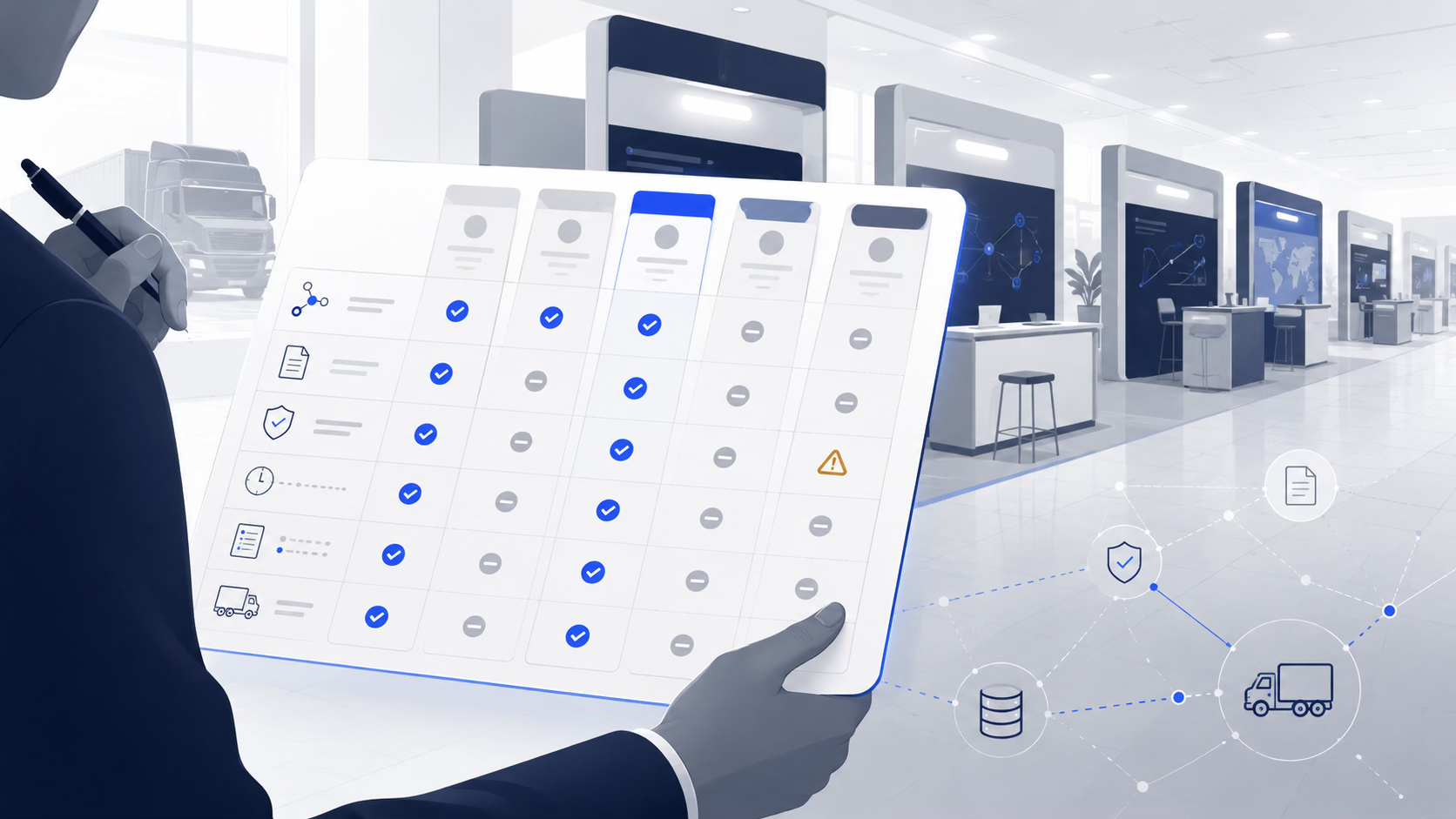
The McLeod Software User Conference is not just a software event for carriers. McLeod User Conference 2026 is a decision point.
The conference brings together industry professionals, fleet managers, truckload carriers, private fleets, exhibitors, McLeod Certified Partner companies, and other software solutions across the transportation industry.
That makes it a natural place to evaluate artificial intelligence vendors. But the AI conversation can get noisy fast. Some vendors will show polished chat experiences. Others will talk about real-time insights, digital freight matching, analytics, or automation. Some will focus on dashboards. Some will focus on generic copilots.
Carriers should ask a harder question: can this AI actually execute work across McLeod and the rest of our stack?
If the answer is unclear, keep asking.
Start With The Business Problem, Not The Demo
A good AI demo can make a product feel more mature than it is. That is especially true when the demo happens in a conference booth, a short meeting, or a crowded exhibitor hall.
Before McLeod User Conference meetings begin, align internally on the workflows that matter most. For many carriers, the priority list looks like this:
- Automate order entry from rate confirmations, emails, PDFs, and BOLs.
- Pull driver, load, truck, trailer, and customer context without switching systems.
- Reduce manual check calls and status update work.
- Prepare customer updates using live load and telematics context.
- Route safety follow-ups with the right event history and audit trail.
- Support after-hours dispatch, wake-up calls, breakdown triage, and exception management.
The goal is not to buy AI because AI is popular. The goal is to reduce the cross-system work that slows business operations every day.
Question 1: Can The AI Connect To McLeod?
This should be the first filter.
Ask the vendor which McLeod products and workflows they support. Can the AI read from LoadMaster? Can it support PowerBroker if needed? Can it work with the McLeod Software APIs or supported integration paths? Is the vendor a McLeod Certified Partner, or do they connect another way?
You are not looking for a vague “yes, we integrate” answer. Ask them to show the workflow, not just the logo. A credible vendor should be specific about what it can read, what it can write, what requires approval, and what is on the roadmap.
Question 2: Can It Write Back Safely?
Reading from McLeod is useful. Writing back safely is where operational value compounds.
If an AI tool can only summarize information, your team still has to do the data entry. That may save a few minutes, but it does not remove the bottleneck. For workflows like order entry, customer updates, check call notes, appointment changes, or safety follow-up logs, the AI should be able to stage the action and let a human approve it.
Ask:
- Which fields can the AI write back to McLeod?
- Does it require approval before making consequential changes?
- Can permissions restrict who can approve which actions?
- Can the AI explain why it is recommending the write-back?
- Can it show the source data behind the action?
- What happens if required fields are missing or validation fails?
A vendor should not treat safety as an afterthought. Good AI for fleet operations gives teams control by default.
Question 3: Can It Automate Order Entry?
Order entry is one of the best tests of an AI vendor because it touches so many real operational problems.
A strong system should be able to read a rate confirmation or BOL, extract the right fields, normalize equipment type, identify the customer, validate required data, detect duplicates, flag exceptions, and prepare the order in McLeod.
Ask vendors to walk through the full workflow: document intake, field extraction, customer ID resolution, validation, exception handling, dispatcher review, and TMS write-back. If the vendor only shows document extraction, that is not full order entry automation. Extraction is one step. The workflow is what matters.
Question 4: Can It Pull Context Across The Rest Of The Stack?
McLeod is critical, but it is not the whole operation.
Most carriers also rely on ELD, telematics, maintenance, email, phone, safety, document management, and communication tools. A practical AI vendor should work across those systems, not force dispatchers to keep stitching the story together manually.
Ask whether the AI can combine:
- Load details from McLeod.
- GPS, HOS, and driver context from ELD and telematics.
- Open work orders or service issues from maintenance systems.
- Customer emails, special instructions, and prior updates.
- Driver communication history from phone, SMS, or voice tools.
- Safety events, coaching history, and compliance notes.
This is where real-time insights become useful. A dashboard may show that a truck is late. An operational AI layer should tell the team why, what has already been checked, what should happen next, and what action is ready for review.
Question 5: What Requires Human Approval?
AI vendors should be able to draw a clean line between low-risk automation and consequential action.
Low-risk tasks might include pulling data, summarizing context, drafting a message, preparing an order, or flagging an exception. Consequential actions might include submitting an order, changing a load, notifying a customer about a service failure, updating appointment details, or taking action that affects driver pay, compliance, or customer commitments.
Ask vendors:
- Which actions can the AI take autonomously?
- Which actions are staged for approval?
- Can rules differ by role, user, department, or workflow?
- Can admins change approval rules without engineering help?
- Does the AI explain what it is about to do before it does it?
If a vendor says the AI “handles everything” without explaining controls, that is a risk signal.
Question 6: Is There A Real Audit Trail?
Fleet operations need traceability. That is true for customer service, safety, compliance, billing, claims, and internal process improvement.
Do not settle for a generic activity log. Ask to see the audit trail.
A useful audit trail should show:
- The user request.
- The systems queried.
- The parameters sent.
- The data returned.
- The AI’s reasoning or decision path at a practical level.
- The recommended action.
- The human approval or rejection.
- The final write-back or message sent.
This matters because AI errors are not always obvious in the moment. If something goes wrong, fleet leaders need to know whether the source data was wrong, the integration failed, the AI misunderstood the request, or the user approved the wrong action.
Question 7: How Does It Work During And After The Conference?
The annual user conference is a good place to discover new ideas, attend educational sessions, join breakout sessions, compare software solutions, and build networking opportunities. But the buying process should not end at the booth.
Before leaving Nashville, Tennessee, ask each vendor for a post-conference proof plan.
That plan should name the first workflows to test, required McLeod access, other systems needed, human approval points, success metrics, and the timeline for getting a real carrier workflow live.
Also confirm the basics from the official website before booking travel or meetings. Search results can mix unrelated items, including McLeod Health, older event references, or venues like Charlotte Convention Center. For UC26, use McLeod’s official event and conference pages as the source of truth.
A Simple AI Vendor Checklist For McLeod User Conference
Use this checklist before, during, and after your vendor meetings:
- Connects to McLeod Software and can show the workflow.
- Reads live load, driver, customer, order, and appointment context.
- Writes back only with clear permissions and approval controls.
- Automates order entry beyond basic document extraction.
- Works across telematics, ELD, maintenance, email, phone, and safety tools.
- Supports audit trails for every query, recommendation, approval, and action.
- Separates reversible automation from consequential actions.
- Lets fleet managers configure roles, access, and escalation paths.
- Handles exceptions instead of hiding them.
- Can prove value on one workflow before expanding across the operation.
The Bigger Question: Who Should Be The Integration Layer?
The main reason AI matters in transportation is simple: humans should not have to be the integration layer anymore.
AI should handle that legwork, while people handle the decisions.
That is the standard carriers should bring to McLeod User Conference 2026. Do not evaluate AI vendors only on what they can say. Evaluate them on what they can do, what they can safely write back, what they can prove inside McLeod, and how much cross-system work they can remove from your team.
Hyperscale built Vic for that kind of execution. Vic connects to the systems carriers already run, including McLeod, and helps teams execute operational work across TMS, telematics, email, maintenance, safety, and communications workflows. Your systems of record stay in place. Your team stays in control. The repetitive work moves faster.
About Hyperscale Systems
Hyperscale Systems has pioneered a unified AI command center that transforms operational communications across physical industries. Founded by logistics technology veterans with deep expertise from leading companies like Samsara, Hyperscale integrates seamlessly with major TMS, FMS, and telematics providers to deliver contextual agentic workflows that eliminate operational bottlenecks while enhancing human capability.