
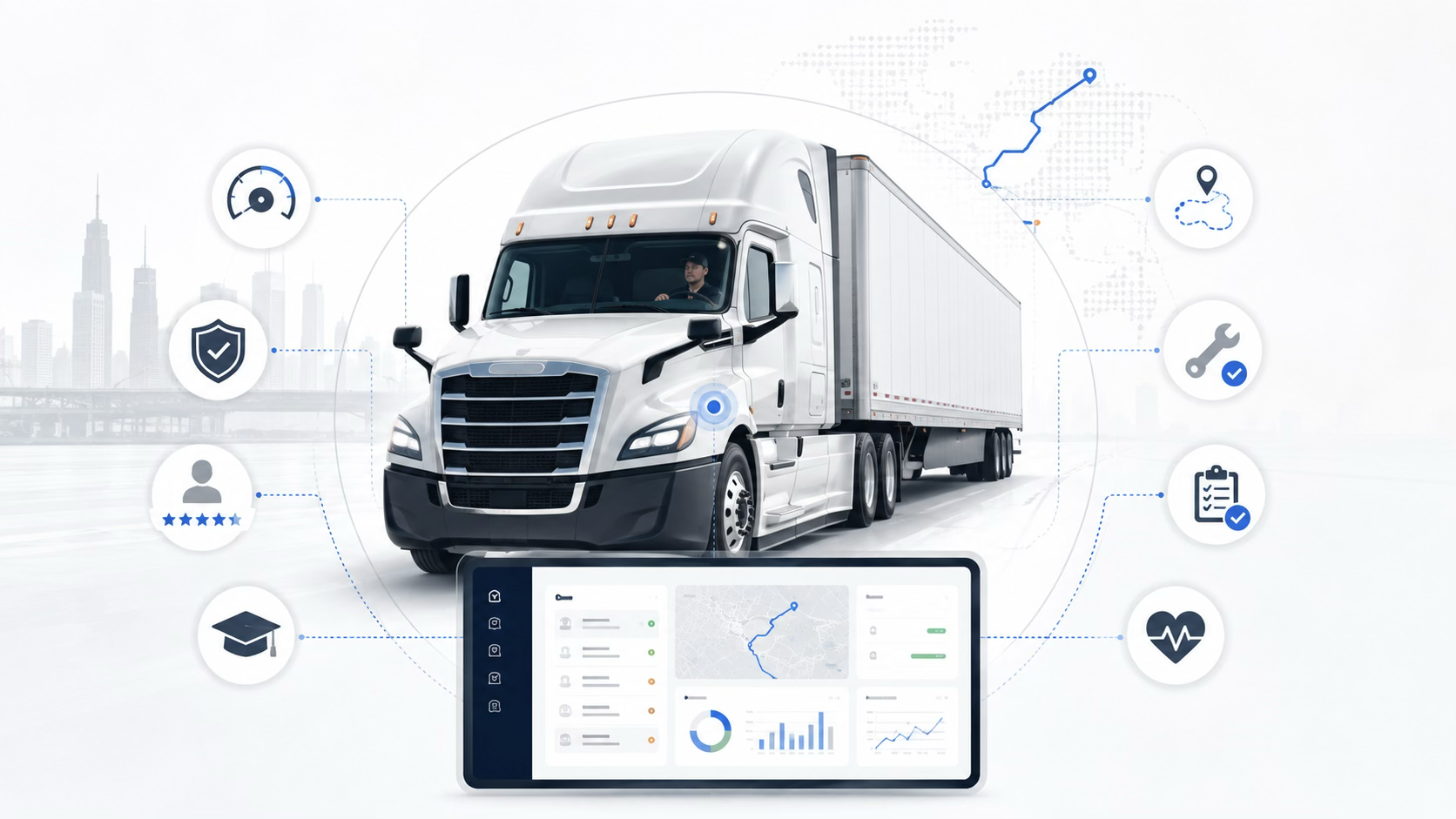
A driver management system gives fleet leaders one operating view of the people behind the wheel. Instead of treating safety, productivity, communication, compliance, and vehicle data as separate workflows, it connects the information needed to manage drivers more consistently.
That matters because driver management rarely lives in one tool. A carrier may use a TMS for loads, a fleet management system for assets, telematics for location and behavior, a maintenance platform for vehicle maintenance, and separate systems for training, payroll, safety, and communication. The data exists, but the work of combining it often falls on dispatchers and driver managers.
The goal of modern driver management software is not simply to collect more data. It is to make the right information easier to act on.
What Is a Driver Management System?
A driver management system is software or an operational layer that helps a fleet monitor, support, coach, and manage drivers across daily operations. It can bring together driver performance, driver safety, compliance status, GPS tracking, telematics data, assignments, training history, vehicle condition, and communication.
Depending on the platform, teams may access that information through web dashboards, a mobile app, alerts, automated workflows, or conversational tools. The strongest setups connect to the systems already used for fleet management, dispatch, safety, maintenance, and fuel instead of forcing operators to rebuild every workflow in a new application.
For carriers that already run multiple systems, the opportunity is often to connect them. Hyperscale’s Terminal, for example, is positioned as an intelligence layer over existing trucking systems, allowing teams to look across TMS, telematics, safety, maintenance, email, and other sources without replacing the systems of record.
What Driver Management Software Should Bring Together
Driver Performance and Safety Data
A useful driver management system should make driver behavior visible in context. That can include speeding events, harsh braking, hard braking, harsh cornering, seat belt events, idle time, and other behavior captured by telematics or dash cams.
A single event should not automatically define a driver. Fleet leaders need trends, operating context, and meaningful performance metrics. A safety score can help prioritize coaching, but it works best when paired with actual event data, driver history, and human review.
That creates a better foundation for safe driving programs and targeted driver training. Instead of giving every driver the same generic coaching, managers can focus on repeat patterns, recent events, and the situations that create the most risk.
Location, Routing, and Real-Time Visibility
Real-time tracking and real-time data help driver managers answer operational questions quickly: Where is the driver? Is the load on schedule? Is a route deviation meaningful? Does the driver have enough time to complete the next move?
Modern fleet tracking combines GPS tracking with dispatch and load context. Geofencing can add automated arrival or departure signals, while route planning and route optimization can help teams compare the planned move with what is actually happening on the road.
The important part is operational context. A map dot by itself is not driver management. The value comes from connecting location to appointments, hours, customer commitments, equipment, and the next required action.
Vehicle Health and Maintenance
Driver performance cannot be separated from vehicle health. A driver may report a vibration, warning light, tire issue, or performance problem before a scheduled inspection catches it. A connected driver management workflow should make it easy to pair those reports with fault codes, inspection history, service reminders, and open work orders.
This supports more consistent vehicle maintenance and, where data quality is strong enough, predictive maintenance programs. The goal is not to predict every failure. It is to reduce the chance that useful driver observations, telematics signals, and maintenance data remain isolated from one another.
Fuel Management and Efficiency
Fuel is one of the clearest places where behavior and operations intersect. Excessive idling, route choices, speed, vehicle condition, and load characteristics can all affect fuel consumption.
A driver management system can support fuel management by combining fuel transactions with telematics, route data, and driver trends. That gives managers a more useful view of driver efficiency than simply ranking drivers by raw fuel use.
Used carefully, this can identify coaching opportunities and operational changes that improve fleet efficiency and create measurable cost savings without reducing safety or service quality.
How a Driver Management System Improves Fleet Operations
1. It Replaces Manual Cross-System Lookups
Many driver managers still act as the integration layer between systems. To answer one question, they may open a TMS, telematics portal, maintenance platform, email thread, and phone system.
A connected approach to fleet operations lets teams pull the relevant information together. That makes it easier to manage your fleet by exception rather than spending the day searching for data.
2. It Makes Coaching More Consistent
When driver performance and safety events are visible in one place, managers can build repeatable coaching workflows. A harsh event can trigger review, a conversation, documented follow-up, and assigned training instead of disappearing into a dashboard.
Consistency matters because effective driver management is not just monitoring. It is the feedback loop between what happened, how the driver understands it, and what the team does next.
3. It Reduces Administrative Work
Driver workflows often include status updates, document collection, appointment details, communication, and sometimes back-office processes such as invoicing. Automation can route routine tasks, surface missing information, and reduce repetitive data entry.
That does not mean every decision should be automated. The best workflow is often: software gathers the context, completes routine steps, and brings a person in when judgment is required.
4. It Connects Drivers to the Broader Fleet Management System
A driver management system should complement the broader fleet management software stack. Driver data becomes more useful when it can be related to asset utilization, maintenance, fuel, route performance, customer service, and dispatch.
This is where connected systems create leverage. Hyperscale’s approach is to sit above existing systems so operators can ask questions and run tasks across them, rather than replacing the TMS, telematics, or maintenance platforms that already hold the underlying records.
What to Look for in Driver Management Software
When evaluating a platform, focus on how well it fits actual operations.
- Integration depth: Can it connect to your TMS, fleet management system, telematics provider, safety tools, maintenance software, and communication channels?
- Real-time workflows: Does it use current location, safety, and telematics data, or only static reports?
- Actionability: Can the system move from dashboards to workflows, alerts, coaching, and follow-up?
- Mobile support: Can drivers and managers use a mobile app or other field-friendly interface where appropriate?
- Human control: Can operators review consequential actions before they are completed?
- Auditability: Can you see what data was used, what action was taken, and why?
- Operational fit: Does it support dispatch, safety, maintenance, fuel, and driver communication without creating another isolated silo?
From Driver Data to Better Decisions
The biggest advantage of a driver management system is not a prettier dashboard. It is the ability to connect data that normally lives apart.
A safety manager can see whether repeated harsh braking is tied to a route pattern. A driver manager can connect idle time with appointments and detention. Maintenance can compare a driver-reported issue with vehicle health data. Operations can use route optimization, location, and performance history to improve planning.
That is how driver management moves from monitoring to decision support.
Build a More Connected Driver Operation
The most effective driver management systems help teams act earlier, coach more consistently, and spend less time gathering information. They connect driver safety, driver behavior, fuel consumption, GPS tracking, telematics, maintenance, and operational workflows without losing the human judgment that trucking requires.
For fleets already operating across multiple systems, the next step may not be another standalone application. It may be an intelligence layer that connects the tools already in place and gives driver managers a faster way to understand what needs attention.
About Hyperscale Systems
Hyperscale Systems has pioneered a unified AI command center that transforms operational communications across physical industries. Founded by logistics technology veterans with deep expertise from leading companies like Samsara, Hyperscale integrates seamlessly with major TMS, FMS, and telematics providers to deliver contextual agentic workflows that eliminate operational bottlenecks while enhancing human capability.