
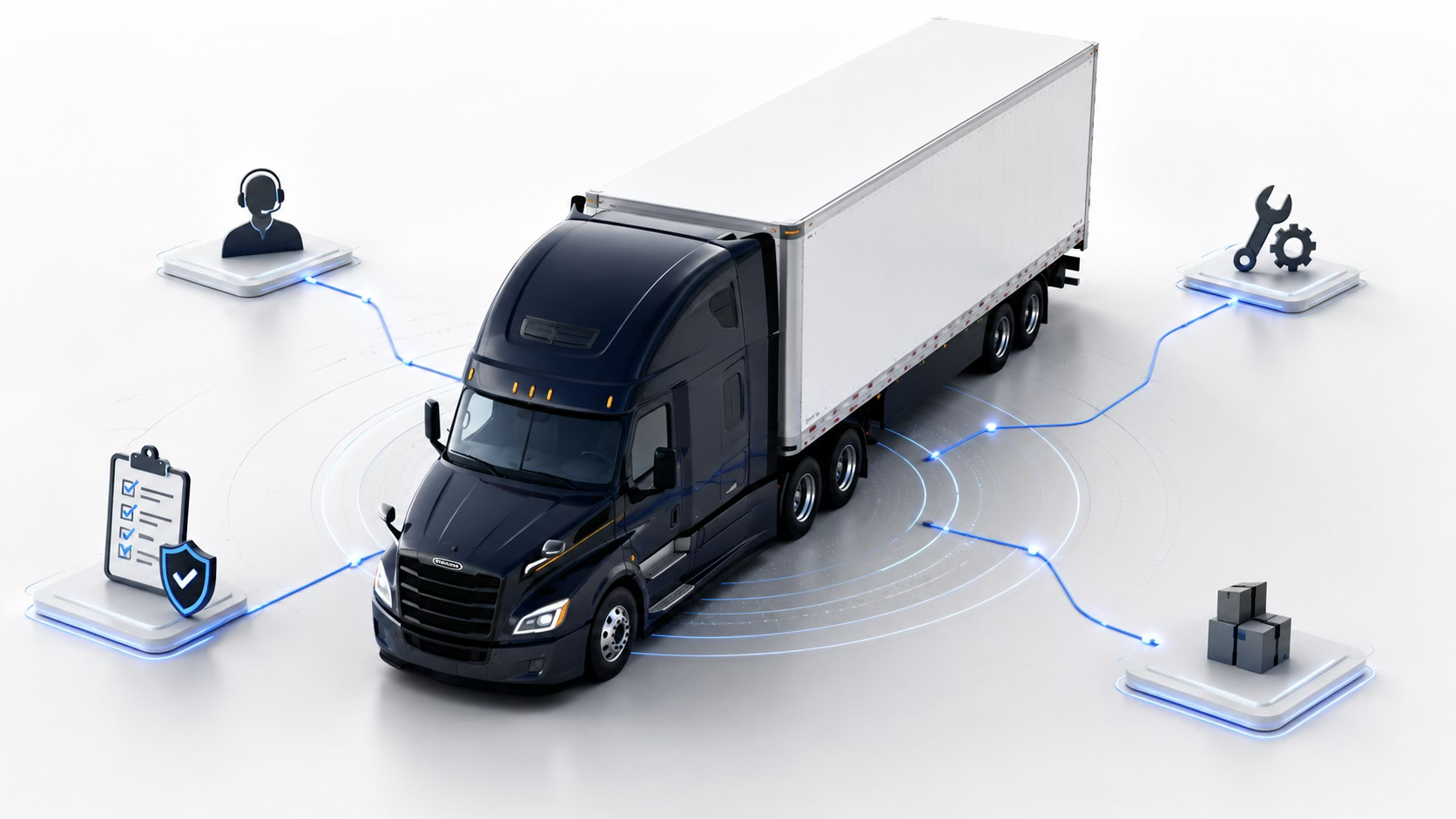
Most carriers already have the tools they need. The problem is that the tools do not always work together.
A fleet may use one system for fleet management, another for telematics, another for ELD data, another for vehicle maintenance, another for fuel management, another for dispatch, and another for email or driver communication. Each system has value. But daily fleet operations still depend on people stitching those systems together.
That is the real challenge behind connected fleet management.
A connected fleet operations platform should not be another dashboard to check. It should be an operational layer that brings fleet data, driver communication, dispatch workflows, maintenance signals, compliance needs, and AI-assisted action into one place.
Connected Fleet Management Starts With The Work
Many fleet management solutions focus on visibility: where assets are, how vehicles are performing, what drivers are doing, and where costs are rising. GPS fleet tracking, vehicle tracking, real-time monitoring, and asset tracking help leaders understand the operation.
Visibility matters, but visibility alone does not run the fleet.
A dispatcher still has to assign loads. A driver manager still has to answer driver questions. A safety lead still has to follow up on driving behaviors. A maintenance team still has to act on fault codes and preventive maintenance needs. A back-office team still has to enter orders and update customers.
The best connected fleet solutions start with the actual work. They ask what the team needs to do next, what information is required, and which systems need to be connected so the next action is clear.
The Core Systems A Connected Platform Should Bring Together
A modern carrier’s technology stack usually includes several important systems. The goal is not to replace them. The goal is to connect them so people do not become the integration layer.
TMS And Dispatch Workflows
The TMS is usually the system of record for loads, customers, appointments, movements, and revenue. A connected platform should read from it, write back to it when approved, and use it as the operational anchor for dispatch workflows.
If a dispatcher asks about a load, the platform should pull current load details, stops, appointment times, assigned driver, and status without forcing a search across multiple screens.
Telematics, ELD, And Vehicle Location
Telematics and electronic logging devices provide live operational context. They can show vehicle location, hours of service, mileage tracking, idling, fuel usage, and driver behavior monitoring.
That data becomes more useful when it is connected to dispatch work. A truck’s location is interesting. A truck’s location compared with its appointment time, driver’s hours, and load priority is operationally useful.
Maintenance, Fuel, And Equipment Health
Vehicle maintenance data is another critical layer. Preventive maintenance, fault codes, open work orders, inspections, and predictive maintenance signals can all affect dispatch decisions.
Fuel costs also shape daily planning. Fuel consumption, route planning, route optimization, idling, and fuel management all affect fleet efficiency. Better fuel decisions can also support sustainable fleets by reducing wasted miles, idle time, and avoidable fuel burn.
What A Truly Connected Fleet Platform Should Do
A connected platform should help operators move from data to decision and improve operational efficiency without adding more manual coordination.
Create One Operational View
Fleet management software often gives leaders useful reports, but operators need a working view. They need driver, load, truck, trailer, appointment, location tracking, compliance, and maintenance context in one flow.
This does not mean every system disappears. It means the platform understands where the right data lives and brings it forward at the right moment.
Support Real-Time Monitoring Without Alert Fatigue
Real-time monitoring is valuable only when teams can separate signal from noise. A platform should not bury dispatch under low-value notifications. It should identify exceptions that matter: a driver may miss an appointment, a vehicle may be sitting too long, hours are getting tight, or a maintenance issue may affect the next load.
The goal is fewer surprises, not more alerts.
Connect Driver Behavior To Coaching And Operations
Driver behavior matters for safety, fuel consumption, compliance management, and customer service. Harsh braking, speeding, idling, route deviations, and other driving behaviors can point to risk or waste.
Coaching works best when the data is actionable. A connected platform should help teams identify which drivers need follow-up, provide context behind the event, and support consistent safety guidance without forcing managers to dig through disconnected reports.
Use APIs To Reduce Manual Work
The API layer turns connected fleet management from a reporting idea into an operating system. When systems can exchange data, teams can automate repetitive handoffs.
For example, a platform can pull telematics data, check TMS status, reference maintenance records, and prepare a customer update. Without API connectivity, someone has to copy and paste across tools.
Track KPIs Operators Can Act On
KPIs should not live only in monthly reviews. Operational performance improves when teams can see the right measures while decisions are being made.
Useful KPIs may include on-time performance, dwell time, idle time, fuel usage, maintenance readiness, hours-of-service risk, load status, driver response times, and exception volume. The important part is actionability.
Where AI Fits Into Connected Fleet Operations
AI is useful in fleet operations when it can work across connected systems. A generic chatbot cannot do much if it cannot see the data or take the next step.
An AI operations layer can help by looking up driver, load, truck, and trailer information across systems; preparing load updates based on vehicle location and ETA; reading rate confirmations; checking hours of service before recommending a driver action; surfacing maintenance context before a truck is assigned; and helping safety teams follow up on driver behavior events.
This is where connected fleet management becomes more than dashboards. The platform does not only show information. It helps the team act on it.
Connected Does Not Mean Replacing Your Existing Stack
One mistake carriers can make is assuming that connected fleet management requires a full system replacement. In many cases, the better approach is to keep the systems that already work and add an intelligence layer on top.
That is especially important for mid-to-large carriers with established workflows. The TMS, telematics provider, ELD, maintenance platform, and communication tools may already be deeply embedded in the operation. Replacing everything creates risk.
A connected layer should read from and write to existing systems with the right permissions, approvals, and audit trail. It should help teams use their current technology better.
Some providers focus heavily on fleet data, connected vehicles, telematics, and performance visibility. Those capabilities can be valuable. But carriers also need the operating layer that connects visibility to dispatch decisions, driver communication, order entry, compliance work, and customer updates.
What To Look For In Connected Fleet Management Solutions
When evaluating connected fleet management solutions, look beyond the dashboard.
Ask whether the platform can connect to the TMS, telematics, ELD, maintenance, phone, email, and safety systems you already use. Look for support for dispatch and driver communication workflows, not only executive reporting. The platform should use real-time data to flag exceptions, improve fleet efficiency through better routing and fewer manual handoffs, support compliance management around hours of service, and help manage fuel costs through fuel consumption insights, idling visibility, and route optimization.
A good connected platform should make the work easier for the people running the fleet every day.
How Hyperscale Approaches Connected Fleet Operations
Hyperscale is built around a simple idea: fleet teams should not have to open six systems to complete one task.
Vic, Hyperscale’s AI superagent, sits on top of the systems carriers already use. It can help teams look up information, run repetitive workflows, prepare order entry, support driver communication, and keep humans in control for approval and judgment.
That makes Hyperscale different from a traditional fleet management dashboard. The focus is not only on seeing the fleet. The focus is on helping the team get work done across the fleet operation.
For a dispatcher, that might mean asking a question in plain language and getting a load, driver, location, and hours-of-service answer in one place. For an operations leader, it might mean giving the team a way to handle more routine work without adding more manual steps.
The Future Of Connected Fleet Management Is Action-Oriented
Connected fleet management should help carriers move faster with the systems they already trust.
The next step is not another screen. It is a connected operations layer that brings together real-time data, driver context, vehicle tracking, maintenance signals, compliance needs, fuel management, and dispatch workflows.
When that layer includes AI, the platform can do more than report. It can help prepare work, surface exceptions, guide follow-up, and reduce the routine coordination that slows teams down.
That is what connected fleet operations should look like: existing systems connected, repetitive work reduced, operators in control, and the team focused on decisions that actually move the fleet.
About Hyperscale Systems
Hyperscale Systems has pioneered a unified AI command center that transforms operational communications across physical industries. Founded by logistics technology veterans with deep expertise from leading companies like Samsara, Hyperscale integrates seamlessly with major TMS, FMS, and telematics providers to deliver contextual agentic workflows that eliminate operational bottlenecks while enhancing human capability.