
AI for trucking has been stuck in the same place for too long.
For years, most artificial intelligence in the trucking industry has been sold as visibility, analytics, or a smarter way to search. That was useful. Fleet operators needed better data from the TMS, ELD, telematics, maintenance systems, email, and phone logs. They needed route optimization, predictive analytics, and better alerts around service risk, driver behavior, fuel consumption, and safety events.
But insight is not the same as execution.
A dashboard can tell a dispatcher a load is at risk. It cannot call the driver, check hours, pull the load record, draft a customer update, log the action, and ask for approval before writing back to the transportation management system. A chatbot can answer a question. It usually cannot complete the workflow.
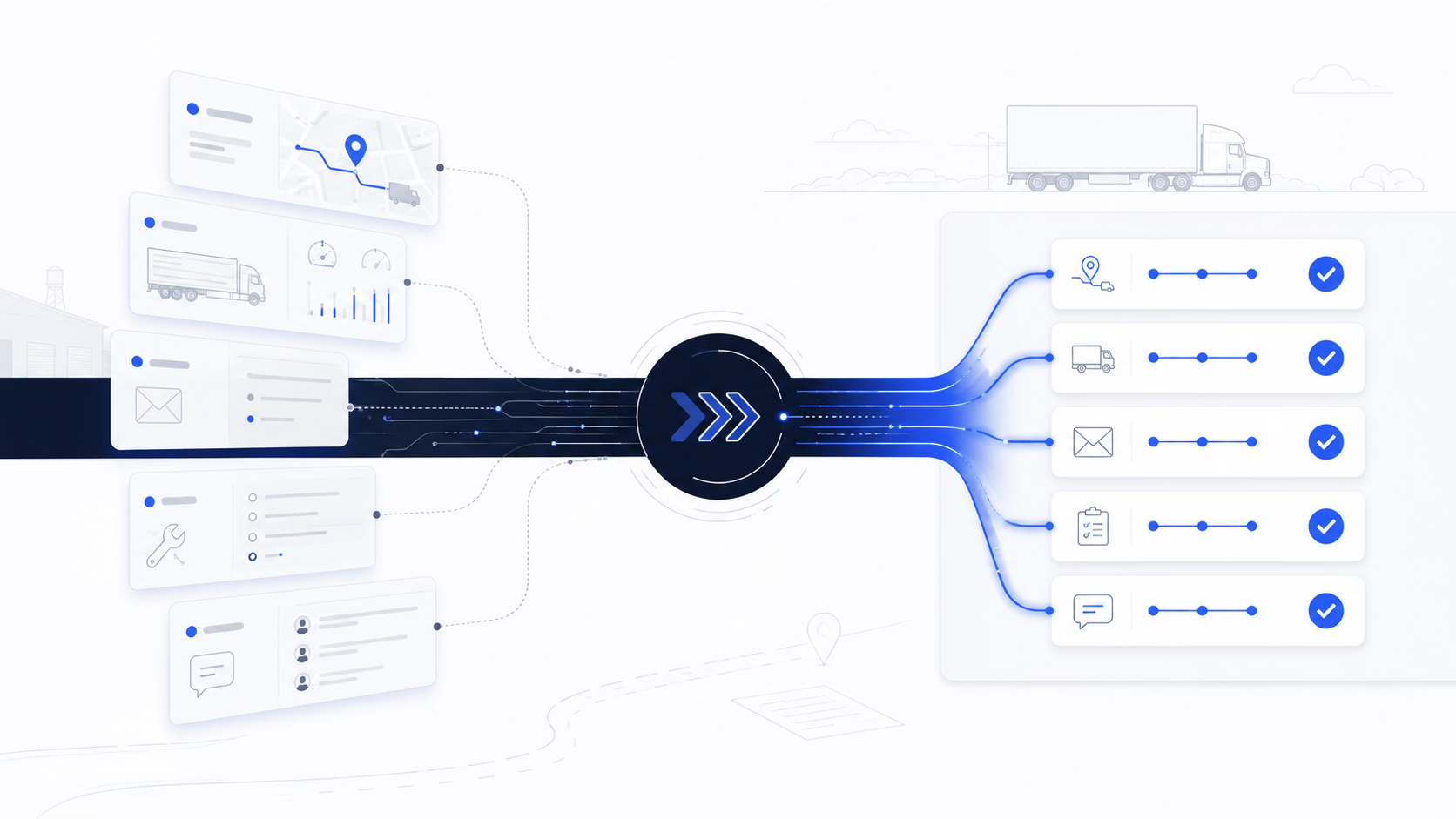
That is the shift happening now. The next phase of AI for trucking is not more screens. It is AI agents that do the repetitive cross-system work while humans stay in control of judgment, exceptions, and relationships.
Why Visibility Was Only Phase One
The first wave of fleet management technology made operations easier to see. TMS platforms organized orders. Telematics and ELD systems gave teams location, HOS, and driver data. Maintenance platforms tracked work orders and predictive maintenance needs. Safety tools surfaced events, scores, and coaching opportunities.
Each system made one part of the operation better. The problem is that the work rarely lives in one system.
A simple driver/load lookup might require McLeod for load details, Samsara or Motive for location and hours, Fleetio for open maintenance issues, email for customer context, and a phone system or SMS tool for communication. Order entry might start from a rate confirmation in email, require OCR, customer ID matching, equipment normalization, duplicate checks, and TMS validation.
That means the human becomes the integration layer.
The dispatcher, driver manager, or back-office teammate has to remember where every answer lives, copy information between systems, and decide what to do next. This is not strategic problem-solving. It is tab-switching, rekeying, checking, and chasing.
Why Chat Alone Is Not Enough
Generative AI made people rethink what software interfaces could look like. Large language models, or LLMs, made it possible to ask questions in plain language instead of clicking through menus. Natural language processing, NLP, and speech recognition made voice and text interfaces feel more natural. ChatGPT made millions of people comfortable asking software to summarize, draft, reason, and explain.
That is why so many trucking teams are now looking at gen AI.
But there is a gap between chat and work.
Chatbots can be helpful for support, FAQs, and simple knowledge retrieval. They can explain a policy or summarize a document. In fleet operations, though, the real value is not the answer. It is the action that follows the answer.
For example:
- If a driver asks for load instructions, the AI should pull the load, confirm the stop details, check special notes, and send the right response.
- If a rate confirmation arrives, the AI should extract the fields, validate the order, flag issues, and stage the TMS entry for review.
- If a customer asks for an ETA, the AI should check the load, location, HOS risk, and recent communications before drafting the update.
- If a safety event occurs, the AI should gather the context, draft coaching notes, and route the follow-up to the right manager.
This is where agentic AI matters. The interface may look conversational, but the value comes from execution across systems.
What Execution Looks Like in Real Fleet Operations
Execution does not mean unsupervised automation. It means AI can take a task from request to ready-for-review without forcing a human to do every lookup and keystroke.
In trucking, that can include:
Order Entry
A carrier receives a rate confirmation by email. AI reads the attachment, extracts pickup and delivery details, identifies the customer, checks for missing fields, normalizes equipment type, looks for duplicate orders, and prepares the load in the TMS. The human reviews the details and approves the write-back.
Driver And Load Lookup
A dispatcher asks, “Where is this driver, what load are they on, and is anything at risk?” AI pulls the driver’s GPS from telematics, active load from the TMS, hours from the ELD, and maintenance status from the fleet management system. Instead of giving raw data, it explains what matters.
Check Calls And Customer Updates
AI can monitor load status, identify when a check call is needed, contact the driver through voice or text, log the result, and prepare a customer update. If something looks risky, it escalates instead of burying the issue in another notification.
Safety Follow-Ups
When driver behavior indicates rising risk, AI can assemble event history, review recent coaching, pull clips or notes when available, and draft the next follow-up. The safety team keeps control of the conversation, but the prep work is already done.
Maintenance Coordination
For predictive maintenance and breakdown workflows, AI can check open work orders, service intervals, odometer readings, fault codes, shop options, and driver availability. The goal is not to replace maintenance judgment. It is to remove the manual coordination around it.
The Technical Shift: From Models To Operational Agents
A lot of AI conversations focus on the model. Is it deep learning? Does it use an artificial neural network? Can it reason over big data? Does it use computer vision for documents or images? Can machine learning or unsupervised learning find patterns humans would miss?
Those questions matter, but they are not the whole buying decision for carriers.
Fleet leaders need to know whether the AI can work safely inside a live transportation operation. That means:
- Can it connect to the TMS, ELD, telematics, email, maintenance, and communications stack?
- Can it read and write through APIs without replacing the systems of record?
- Can it show every tool call, every system queried, and every action taken?
- Can it ask for approval before consequential actions?
- Can permissions, roles, and cybersecurity controls limit what the AI is allowed to do?
- Can it adapt to the carrier’s SOPs, customers, lanes, and exception rules?
This is why AI agents matter more than generic automation. Automation usually follows a fixed path. AI agents can interpret a request, select the right tools, gather context, make a recommendation, and stage the work for a human to approve.
Execution Does Not Mean Replacing Humans
The trucking industry does not need AI that pretends dispatch can run without people. It needs AI that removes the low-value work that keeps people from doing their real job.
Humans should make the judgment calls. Should this driver be reassigned? Should the customer be called before the appointment slips? Should the safety team coach now or wait for more context? Should a planner accept a route that saves miles but increases service risk?
AI should do the legwork that supports those decisions.
That is also the difference between AI for trucking and the broader debate around autonomous vehicles, autonomous trucks, self-driving cars, AGI, and artificial general intelligence. Those topics matter, but most carriers do not need to wait for autonomous capacity to get value from AI. They can use AI today to improve order entry, dispatch support, driver communication, safety workflows, maintenance coordination, and risk management.
The near-term opportunity is not replacing the driver or the dispatcher. It is giving the team a system that can run the repetitive work across the stack.
How To Evaluate AI For Trucking Vendors
When carriers evaluate AI tools, they should look past the demo chat window. The better question is not, “Can it answer a question?” The better question is, “Can it complete the workflow safely?”
Ask vendors:
- What systems can the AI connect to today?
- Can it write back to our TMS after review?
- Does it support human approval for consequential actions?
- Can it automate order entry from rate confirmations and BOLs?
- Can it pull driver, load, truck, trailer, and maintenance context in one request?
- Can it support voice workflows using speech recognition for drivers?
- Does it keep an audit trail of every action?
- How does it prevent hallucinated updates, unsafe writes, or unauthorized access?
- Can it work across operations, safety, maintenance, planning, customer service, and accounting?
A useful AI system should reduce manual work without reducing control.
The New Standard: Humans Decide, AI Executes
For a long time, transportation software asked people to meet the system where it was. Log into the TMS. Open the ELD. Check telematics. Search email. Call the driver. Update the customer. Log the note. Repeat.
AI changes that pattern for the transportation industry.
The new standard is one operational layer that can understand the task, move across the systems, and bring the work back to the person in charge. The human still owns the outcome. The AI handles the repetitive execution.
That is the POV behind Hyperscale. Vic is built as an AI Command Center for fleet operations. It connects to the systems carriers already run and helps teams execute the work that usually gets trapped between them: order entry, driver/load lookup, check calls, customer updates, safety follow-ups, maintenance coordination, and more.
AI for trucking is moving from insights to execution because that is where the bottleneck is. Carriers do not need another place to look. They need the work to move.
About Hyperscale Systems
Hyperscale Systems has pioneered a unified AI command center that transforms operational communications across physical industries. Founded by logistics technology veterans with deep expertise from leading companies like Samsara, Hyperscale integrates seamlessly with major TMS, FMS, and telematics providers to deliver contextual agentic workflows that eliminate operational bottlenecks while enhancing human capability.